There is a moment many parents experience but struggle to explain.
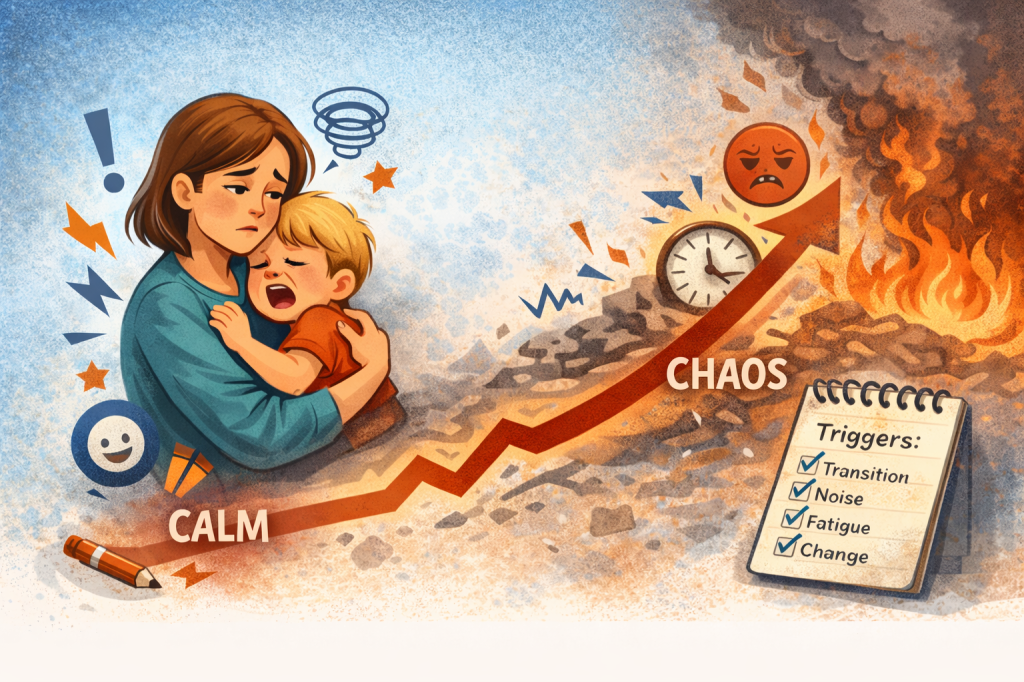
A child moves from calm to overwhelmed in what feels like seconds. What appeared manageable becomes intense, unpredictable, and difficult to de-escalate. The situation resolves eventually, but the aftermath lingers—emotionally, mentally, and physiologically for both the child and the caregiver.
The phrase most often used to describe it is simple:
That escalated quickly.
From a public health and developmental perspective, these moments are often misunderstood when viewed in isolation. What appears to be sudden is frequently the result of cumulative inputs across biological, environmental, and psychosocial systems.
Behavior Is Not Isolated—It Is Contextual
Current research in child development and behavioral health consistently demonstrates that behavior is not random. It is influenced by an interaction of multiple systems, including:
- Nervous system regulation
- Environmental stimuli
- Communication capacity
- Sleep and nutritional status
- Emotional and social demands
The biopsychosocial model, widely used in public health and clinical settings, emphasizes that health and behavior outcomes are shaped by the interaction of biological, psychological, and social factors (Engel, 1977).
Similarly, the Social Ecological Model highlights that individual behavior is influenced by layers of environment, including family systems, community structures, and broader societal conditions (Centers for Disease Control and Prevention [CDC], 2022).
When applied to childhood behavioral escalation, this means:
What happens in the moment is often the final expression of what has been building across systems.
Nervous System Load and Rapid Escalation
From a neurodevelopmental standpoint, rapid escalation is frequently associated with dysregulation of the autonomic nervous system.
Research in polyvagal theory and stress physiology suggests that children who experience high sensory input, emotional stress, or limited regulatory capacity may transition quickly into fight, flight, or shutdown responses (Porges, 2011).
These responses are not willful defiance. They are adaptive physiological reactions.
When a child’s system reaches threshold, escalation can appear immediate, even if the underlying load has been accumulating over time.
The Hidden Variable: Caregiver Impact
While much of the focus remains on the child, public health literature increasingly recognizes the impact of chronic stress on caregivers.
Parents managing frequent behavioral escalation often experience:
- Elevated stress levels
- Emotional fatigue
- Sleep disruption
- Increased risk of anxiety and burnout
Caregiver burden research indicates that prolonged exposure to high-stress caregiving environments can significantly affect both mental and physical health outcomes (Hayes & Watson, 2013).
In practical terms, many parents are not only responding to escalation, but they are also recovering from it, anticipating it, and adjusting their daily functioning around it.
This creates a pattern of sustained vigilance that is rarely acknowledged in traditional behavioral discussions.
From Isolated Incidents to Pattern Recognition
If escalation were rare, it would be anecdotal.
But when similar experiences are reported across households, it becomes something else entirely:
A pattern.
Patterns allow for:
- Identification
- Measurement
- Intervention
Yet, many families lack the tools or frameworks to track these experiences in a meaningful way.
Without data, patterns remain invisible.
A Data-Informed Approach: Parent Experience Survey
As part of my work as a public health educator and disability advocate and in preparation for my upcoming book, That Escalated Quickly…—I developed a structured survey to better understand:
- Frequency of escalation
- Speed of onset
- Intensity of response
- Recovery time
- Environmental and physiological triggers
- Caregiver impact
The goal is to move beyond assumptions and begin documenting real-world patterns as reported by parents themselves.
Participate in the Survey
If you are a parent or caregiver who has experienced rapid behavioral escalation in your child, your input can contribute to a broader understanding of these patterns.
Responses are anonymous unless you choose to provide contact information for follow-up.
👉 [That Escalated Quickly Survey Link Here]
Access the Companion Resource

This survey is part of a larger project connected to my book:
That Escalated Quickly…
A practical, pattern-focused resource designed to help parents:
- Recognize early escalation signals
- Track behavioral patterns
- Understand contributing factors
- Reduce guesswork in high-stress moments
A digital downloadable version will be available at the end of the book.
Moving Forward: Clarity Over Chaos
When viewed in isolation, escalation feels unpredictable.
When viewed through a systems lens, patterns begin to emerge.
And when patterns emerge, so does the opportunity for more informed, supportive responses—for both the child and the caregiver.
Because if something happens consistently, it is not random.
It is data waiting to be understood.
References
Centers for Disease Control and Prevention. (2022). The social-ecological model: A framework for prevention. https://www.cdc.gov/violenceprevention/about/social-ecologicalmodel.html
Engel, G. L. (1977). The need for a new medical model: A challenge for biomedicine. Science, 196(4286), 129–136. https://doi.org/10.1126/science.847460
Hayes, S. A., & Watson, S. L. (2013). The impact of parenting stress: A meta-analysis of studies comparing the experience of parenting stress in parents of children with and without autism spectrum disorder. Journal of Autism and Developmental Disorders, 43(3), 629–642. https://doi.org/10.1007/s10803-012-1604-y
Porges, S. W. (2011). The polyvagal theory: Neurophysiological foundations of emotions, attachment, communication, and self-regulation. W. W. Norton & Company.
Discover more from Restoration Wellness of Idaho LLC
Subscribe to get the latest posts sent to your email.
 Restoration Wellness of Idaho LLC