
In the last day or so, a curious pattern has unfolded.
A company—DoorDash—is experiencing backlash, not because of a change in its service, but because it was associated with a political message. In response, individuals are canceling accounts, making decisions quickly, and publicly expressing strong emotional reactions.
This is not about DoorDash as a company, nor about any single political figure in isolation. It is about what happens when one becomes associated with the other and how quickly that association can trigger reaction. What follows is not random behavior, but a reflection of how we process, tolerate, or resolve internal conflict.
It is about what happens when emotion moves faster than discernment.
We are living in a time where reaction has become immediate. Information is instant. Opinions are instant. Decisions are instant. And increasingly, so are consequences. But the human mind and body were not designed for constant, unresolved input followed by immediate output.
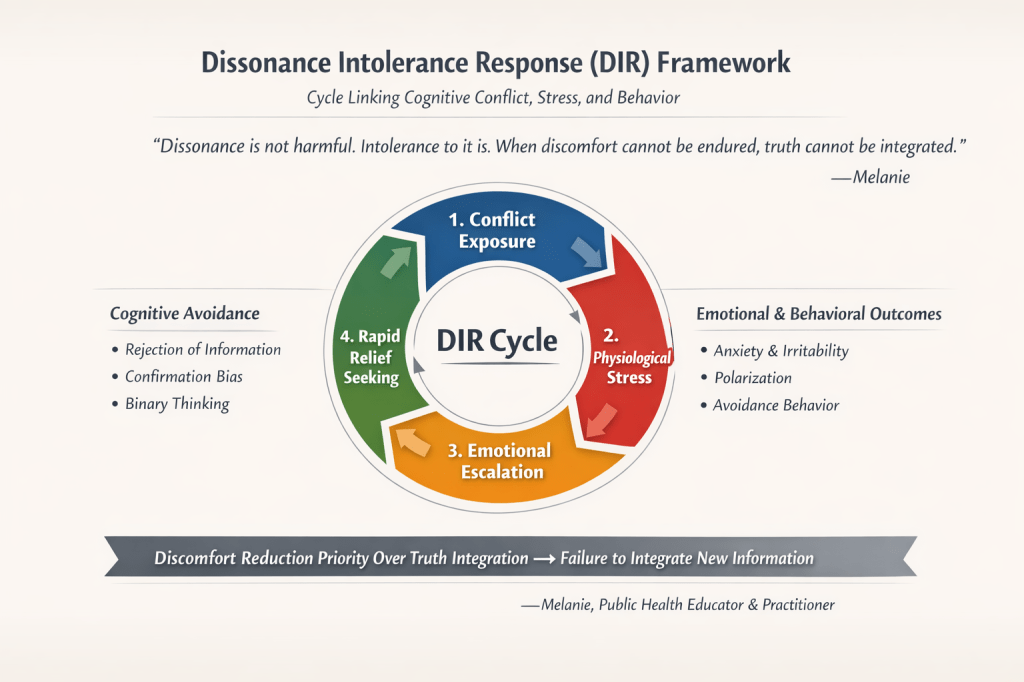
This is where I begin to frame what I call Dissonance Intolerance Response (DIR).
DIR describes what happens when a person encounters something that conflicts with their internal beliefs, expectations, or emotional state—and lacks the capacity or willingness to sit with that tension. Instead of processing the dissonance, the system resolves it quickly. Not accurately. Not thoughtfully. Quickly.
Cognitive dissonance has long been recognized as a natural part of human psychology (Festinger, 1957). It is not the presence of dissonance that creates the issue it is the intolerance of it. When discomfort is perceived as something that must be eliminated immediately, behavior shifts toward rapid resolution strategies. These may include withdrawal, rejection, overcorrection, or emotional reactivity.
We are seeing this play out in real time.
A service that once met a practical need is now being rejected not because the need disappeared, but because the association created internal conflict. Rather than holding that tension and evaluating it, many are resolving it through immediate action.
Cancel. Delete. React.
But here is the deeper question:
Was the decision driven by principle or by an unprocessed emotional response?
Emotions are not inherently wrong. They are signals. But signals are not conclusions. When emotion becomes the sole driver of decision-making, it can distort perception, narrow thinking, and override discernment.
Scripture reminds us that the heart is not always a reliable guide (Jeremiah 17:9). This is not a condemnation it is a caution. Discernment requires pause. It requires the ability to sit in tension long enough to understand what is actually happening before responding to it.
From a physiological perspective, this makes sense. When the nervous system perceives conflict or threat whether physical or ideological, it seeks resolution. If the system is not practiced in tolerating discomfort, it will default to immediate action to relieve it (Porges, 2011; Schore, 2012). Over time, this creates a pattern where reaction replaces reflection.
This is not limited to politics. DoorDash is simply a visible example.
We see the same pattern in relationships, parenting, health decisions, and daily life. Anything that challenges our expectations has the potential to trigger dissonance. The question is not whether dissonance will occur, it will. The question is whether we have the capacity to remain steady in its presence.
Because that is where clarity lives.
DIR is not about eliminating emotion. It is about recognizing when emotion is attempting to resolve something prematurely. It is about creating space between stimulus and response. It is about rebuilding tolerance for discomfort so that decisions can be made with awareness rather than urgency.
In a world where everything is immediate, the ability to pause may be one of the most important skills we recover.
Not everything that feels urgent is true.
And not every reaction is wisdom.
References
Festinger, L. (1957). A Theory of Cognitive Dissonance.
Porges, S. W. (2011). The Polyvagal Theory.
Schore, A. N. (2012). The Science of the Art of Psychotherapy.
The Holy Bible, English Standard Version. (2001). Crossway.
Melanie Long-Azary, Restoration Wellness LLC. (2026). Dissonance Intolerance Response (DIR): Observational framework on emotional reactivity and behavioral patterning.

Designed with WordPress
Discover more from Restoration Wellness of Idaho LLC
Subscribe to get the latest posts sent to your email.
 Restoration Wellness of Idaho LLC