
There is a growing interest in plant-based medicine, but much of the current conversation lacks context. Herbs are often presented as simple solutions to isolated symptoms, removed from both their historical roots and their modern scientific understanding. This creates confusion, inconsistent outcomes, and, in some cases, unsafe application. To practice responsibly, it is necessary to understand how plant medicine has evolved over time and how these frameworks can be integrated into a coherent, clinically informed approach.
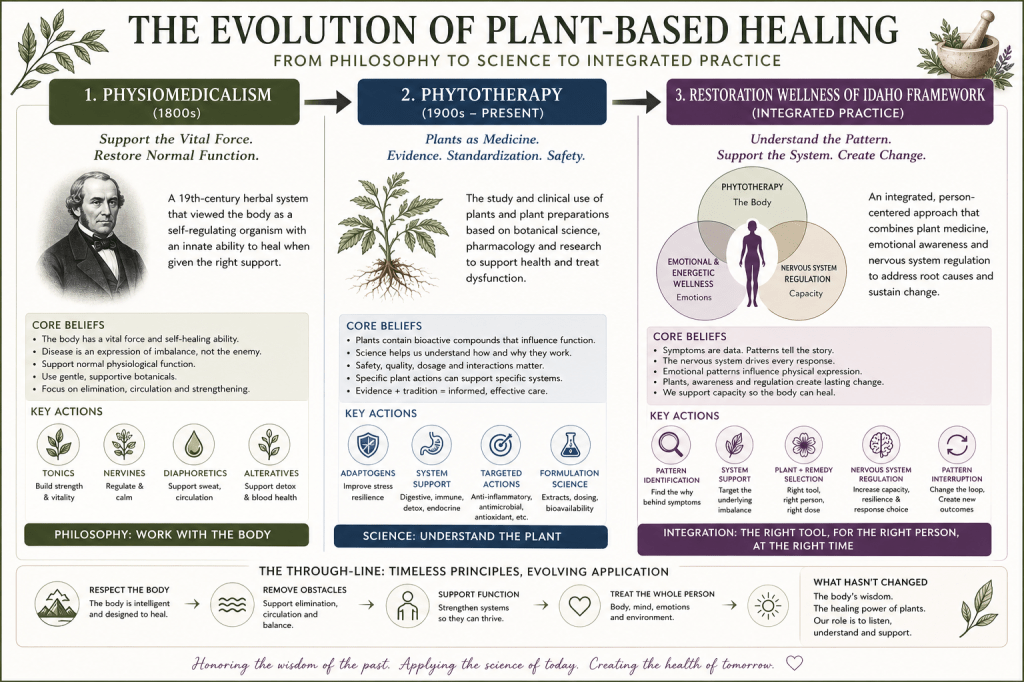
The progression from Physiomedicalism to modern phytotherapy, and now into pattern-based integrative models, reflects an increasing depth of understanding rather than a replacement of ideas. Each stage builds upon the last, refining how practitioners observe, interpret, and support the human body.
Physiomedicalism and the Foundation of Support
Physiomedicalism, which emerged in the nineteenth century, was grounded in the belief that the body possesses an inherent ability to heal when supported appropriately. Practitioners emphasized restoring normal physiological function rather than suppressing symptoms. Disease was viewed not as an external enemy but as an expression of imbalance within the organism.
“Disease is not the enemy. It is the body attempting to restore balance.”
The goal of intervention was to assist the body through gentle means, including tonics, nervines, and eliminative herbs, which supported circulation, tissue integrity, and natural detoxification processes (Coulter, 1988).
This perspective aligns closely with what is now recognized as a systems-based understanding of health. Rather than isolating symptoms, Physiomedicalism encouraged practitioners to observe patterns of dysfunction and support the body’s ability to regulate itself. While limited by the scientific tools of its time, its foundational principle remains relevant: the body is not inherently failing but responding.
Phytotherapy and the Expansion of Clinical Precision
Modern phytotherapy expands upon this foundation by incorporating advances in pharmacology, biochemistry, and clinical research. Rather than relying solely on traditional use, phytotherapy evaluates plant medicines based on their active constituents, mechanisms of action, and physiological effects.
Plants are understood to interact with enzyme systems, receptors, and signaling pathways in measurable ways, allowing for more precise and targeted application (Bone & Mills, 2013).
Importantly, phytotherapy does not abandon traditional knowledge. Instead, it integrates empirical use with scientific validation.
“Clinical herbal practice requires both the history of use and the science that explains it.”
This dual approach allows practitioners to move beyond anecdotal application into a more structured and reproducible model of care.
The Hidden Gap in Modern Health
At the same time, modern patterns of disease reveal an additional layer that must be considered.
Both overnutrition and undernourishment frequently coexist in chronic disease. Many individuals consume sufficient, or even excessive, calories, yet remain deficient in essential vitamins, minerals, and other micronutrients required for proper cellular function. This creates a state in which the body is energy-rich but nutrient-poor, limiting resilience, impairing regulation, and contributing to ongoing dysfunction (Simpson & Raubenheimer, 2005; Popkin, 2017).
“The body can be fed, but still not supported.”
When viewed through a systems-based lens, this imbalance helps explain why isolated interventions often fail. A body that lacks the foundational resources required for repair and adaptation cannot respond effectively, even when targeted therapies are applied.
Pattern-Based Practice and Stress Physiology
A pattern-based approach builds on this understanding by recognizing that symptoms are not isolated events, but expressions of underlying system dynamics.
The nervous system plays a central role in shaping physiological responses. Research in stress physiology, beginning with Hans Selye’s General Adaptation Syndrome, demonstrates that the body’s response to stress follows predictable stages that influence endocrine, immune, and metabolic function (Selye, 1956).
When adaptive capacity is exceeded, dysregulation emerges across multiple systems.
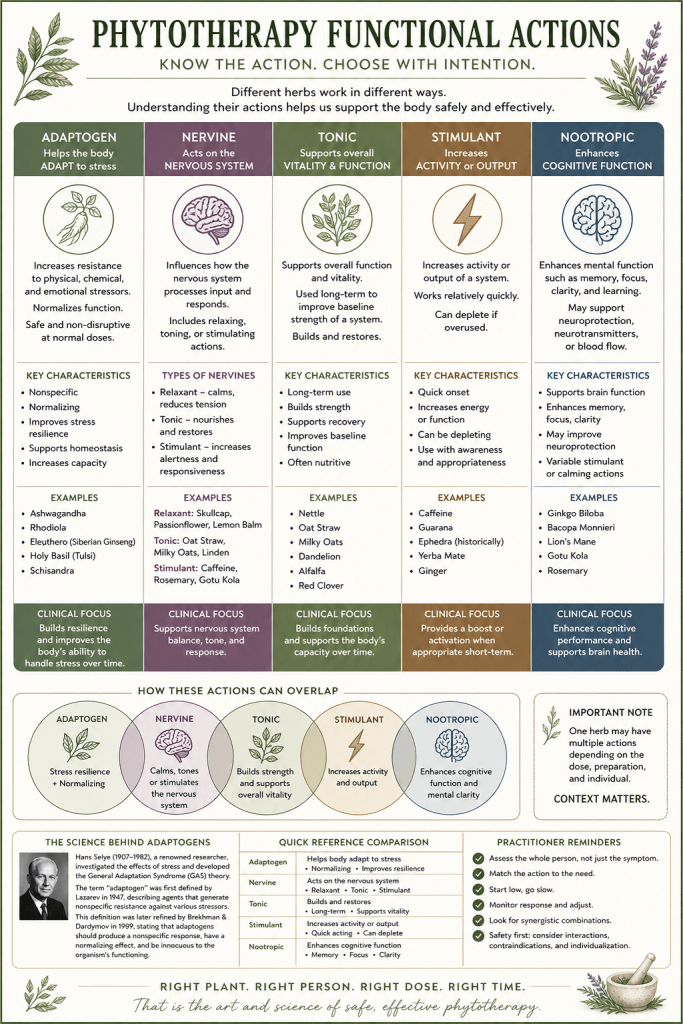
Within this context, plant medicine is not used to suppress symptoms or override the body’s responses. Instead, it is applied to support system capacity, reduce physiological burden, and improve the body’s ability to adapt.
Adaptogens, first described by Lazarev (1947) and later refined by Brekhman and Dardymov (1969), increase nonspecific resistance to stress while exerting a normalizing effect on the body.
“The goal is not to force the body to change, but to improve its ability to respond.”
What This Looks Like in Practice
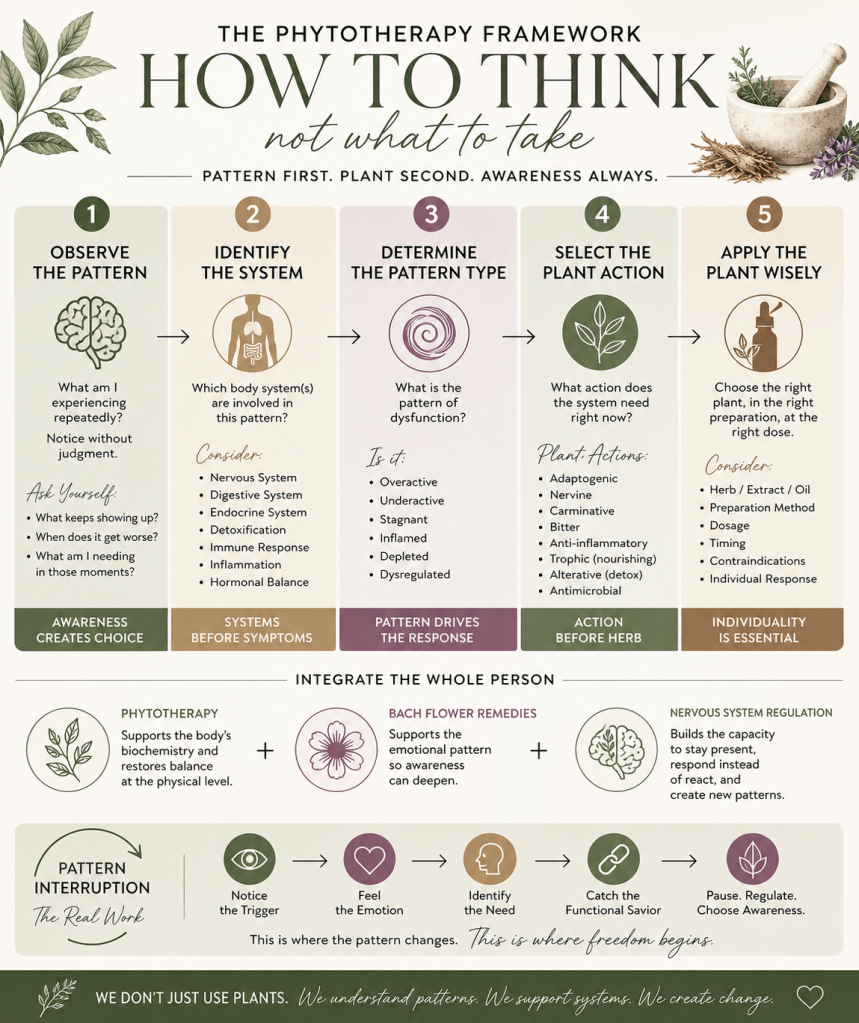
Understanding these frameworks is important, but what matters most is how they are applied in real life.
When I work with clients, the starting point is not a protocol or a product. It is observation.
I look at:
- what is happening in the body
- when it is happening
- what patterns are emerging over time
This includes physical symptoms, stress responses, environmental factors, and nutritional status.
From there, we identify the primary systems involved. In many cases, this includes the nervous system, digestion, and detoxification pathways, as these systems are closely interconnected.
Plant medicine is then selected based on function, not assumption.
Instead of asking what herb is used for a specific condition, the question becomes:
“What action does the body need in order to function better?”
For example, a client experiencing chronic overwhelm may not need something that simply calms the body, but something that improves stress adaptation while also supporting nervous system regulation over time.
Equally important is recognizing when the body does not have the capacity to handle aggressive intervention.
“If the system is overwhelmed, the answer is not to push harder.”
In these cases, the focus shifts to stabilization and support rather than stimulation or detoxification. This often produces more sustainable progress than attempting to force rapid change.
Emotional and behavioral patterns are also considered as part of the process. The way a person responds to stress and interprets symptoms can influence physiological outcomes.
This approach is not built on intensity.
“It is built on consistency, observation, and adjustment.”
Bringing It All Together
The evolution from Physiomedicalism to phytotherapy to pattern-based practice reflects a consistent theme: working with the body rather than against it.
What has changed is not the core principle, but the depth of understanding and the precision of application.
Plant medicine, when applied within this framework, becomes more than an alternative. It becomes a structured, evidence-informed method of supporting human physiology in a way that respects both complexity and individuality.
“The body is not malfunctioning. It is responding to something.”
The work is not to silence that response, but to understand it.
When the pattern is understood, it becomes possible to support systems in a way that creates meaningful and lasting change.
Cited Sources
Bone, K., & Mills, S. (2013). Principles and practice of phytotherapy: Modern herbal medicine (2nd ed.). Churchill Livingstone.
Brekhman, I. I., & Dardymov, I. V. (1969). New substances of plant origin which increase nonspecific resistance. Annual Review of Pharmacology, 9, 419–430.
Coulter, H. L. (1988). Divided legacy: The conflict between homeopathy and the American Medical Association. North Atlantic Books.
Lazarev, N. V. (1947). Pharmacology of adaptogenic substances. Proceedings of the USSR Academy of Sciences.
Popkin, B. M. (2017). Relationship between shifts in food system dynamics and acceleration of the global nutrition transition. Nutrition Reviews, 75(2), 73–82.
Selye, H. (1956). The stress of life. McGraw-Hill.
Simpson, S. J., & Raubenheimer, D. (2005). Obesity: The protein leverage hypothesis. Obesity Reviews, 6(2), 133–142.
Discover more from Restoration Wellness of Idaho LLC
Subscribe to get the latest posts sent to your email.
 Restoration Wellness of Idaho LLC