
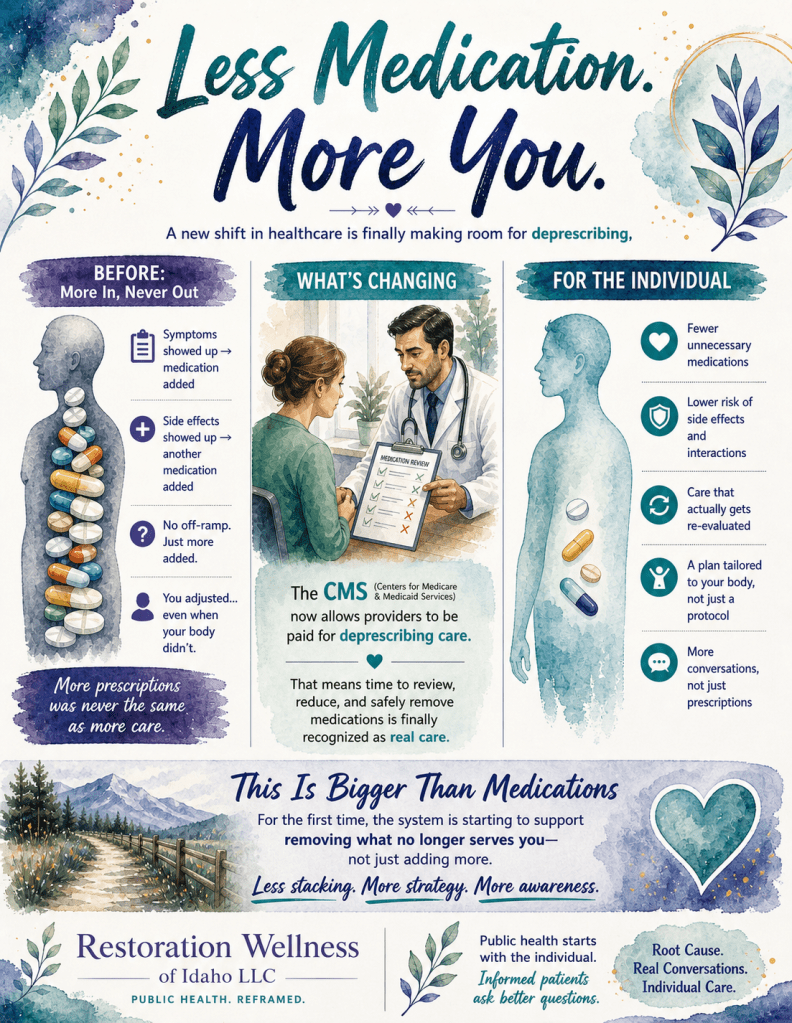
Recent guidance from the Centers for Medicare & Medicaid Services (CMS) signaling reimbursement for deprescribing-related care represents a meaningful shift in the structure of clinical incentives within the United States healthcare system. Historically, reimbursement models have favored the initiation and maintenance of pharmacologic therapies, while offering limited support for the time-intensive process of medication review, tapering, and discontinuation. This imbalance has contributed to the widespread and well-documented issue of polypharmacy, particularly among individuals with chronic conditions and aging populations (Maher, Hanlon, & Hajjar, 2014).
The introduction of billing pathways for deprescribing care has the potential to realign clinical priorities toward ongoing evaluation rather than passive continuation. At the individual level, this shift is not merely administrative. It creates a framework in which patients may more readily engage their providers in conversations about medication necessity, long-term risk, and alternatives to continued pharmacologic intervention. In this context, deprescribing becomes not an act of withdrawal, but an extension of patient-centered care.
Polypharmacy has been associated with increased risk of adverse drug events, drug-drug interactions, medication nonadherence, and functional decline (Wastesson et al., 2018). Despite these risks, medications are frequently continued beyond their period of clinical utility due to fragmented care, time constraints, and a lack of structured incentives to reassess treatment plans. By compensating providers for deprescribing work, CMS acknowledges the clinical complexity involved in safely reducing medication burden and creates space for more intentional care.
For patients, this policy shift introduces an opportunity to advocate more effectively within clinical encounters. Advocacy in this context does not require opposition to medical care, but rather participation in it. Individuals may begin to ask structured, evidence-based questions: whether each medication remains necessary, whether risks outweigh benefits at the current stage of health, and what monitored reduction might look like. These conversations are strengthened when patients are supported in understanding both the pharmacologic and physiologic implications of long-term medication use.
It is within this evolving landscape that phytotherapy, defined as the use of plant-derived compounds for therapeutic purposes, may serve as a complementary framework within collaborative care. Phytotherapy is not positioned as a replacement for necessary medical treatment, but as a potential supportive modality that can be integrated alongside conventional care when appropriate. A growing body of literature suggests that certain plant-based compounds possess clinically relevant anti-inflammatory, antioxidant, and regulatory effects on physiological systems, including the gastrointestinal, nervous, and immune systems (Panossian & Wikman, 2010; Williamson, Driver, & Baxter, 2013).
As deprescribing initiatives progress, one of the central clinical challenges involves supporting the body during periods of physiologic adjustment. The removal or reduction of medications may reveal underlying dysregulation that had previously been masked. This is where a coordinated, interdisciplinary approach becomes particularly valuable. Practitioners trained in phytotherapy and holistic assessment may assist in identifying patterns of imbalance and providing non-pharmacologic support strategies that align with the individual’s overall care plan.
Importantly, this model does not function in isolation from conventional medicine. Rather, it depends on clear communication and defined roles. Physicians oversee diagnosis, medical management, and risk mitigation. As an adjunct practitioner, I contribute an additional layer of support through nutrition, plant-based therapeutics, and lifestyle modulation. When these roles are clearly defined and collaboratively integrated with medical care, the result is not fragmentation, but reinforcement.
For individuals navigating chronic illness, complex diagnoses, or long-term medication use, the integration of multiple perspectives can provide a more comprehensive understanding of their health. Working with a practitioner trained in pattern recognition and whole-person assessment may help individuals prepare for clinical conversations, track symptom changes during deprescribing, and implement supportive strategies that reduce the likelihood of rebound or destabilization.
This collaborative model reflects broader public health principles, including the biopsychosocial framework and the social ecological model, both of which emphasize that health outcomes are influenced by multiple interacting factors beyond isolated clinical interventions (Engel, 1977; McLeroy et al., 1988). Deprescribing, when supported appropriately, aligns with these frameworks by addressing not only the presence of disease, but the overall context in which health is maintained or disrupted.
The CMS policy change does not, on its own, resolve the systemic challenges associated with polypharmacy. However, it represents a structural acknowledgment that reduction of treatment burden is a legitimate and necessary component of care. For patients, this creates a pathway toward more active participation in their health decisions. For practitioners, it opens the door to more balanced, evaluative approaches to treatment. And for public health, it signals a gradual shift toward care models that prioritize long-term outcomes over short-term intervention.
As this transition unfolds, individuals are not required to navigate it alone. When patients engage both their medical providers and qualified adjunct practitioners in a coordinated manner, they position themselves within a support system that is both clinically grounded and individually responsive. In this way, deprescribing becomes not simply the removal of medication, but the restoration of intentional, informed, and collaborative care.
References
Engel, G. L. (1977). The need for a new medical model: A challenge for biomedicine. Science, 196(4286), 129–136.
Maher, R. L., Hanlon, J., & Hajjar, E. R. (2014). Clinical consequences of polypharmacy in elderly. Expert Opinion on Drug Safety, 13(1), 57–65.
McLeroy, K. R., Bibeau, D., Steckler, A., & Glanz, K. (1988). An ecological perspective on health promotion programs. Health Education Quarterly, 15(4), 351–377.
Panossian, A., & Wikman, G. (2010). Effects of adaptogens on the central nervous system and the molecular mechanisms associated with their stress-protective activity. Pharmaceuticals, 3(1), 188–224.
Wastesson, J. W., Morin, L., Tan, E. C. K., & Johnell, K. (2018). An update on the clinical consequences of polypharmacy in older adults. Expert Opinion on Drug Safety, 17(12), 1185–1196.
Williamson, E. M., Driver, S., & Baxter, K. (2013). Stockley’s herbal medicines interactions. Pharmaceutical Press.

Discover more from Restoration Wellness of Idaho LLC
Subscribe to get the latest posts sent to your email.
 Restoration Wellness of Idaho LLC