Welcome to the Jungle Gym (and the IEP Table)
“Regulation comes before education, because a dysregulated brain cannot learn, no matter how cute the bulletin board is.” – Melanie; Practitioner
In approximately one month, we will all be heading back to school, which means it is almost time for the annual ritual known as “The Supply List Breakdown.” You know, that magical moment where you are fighting a stranger over the last 10¢ folder while your kid insists they need the $47 mechanical pencils “because they feel better.”
Soon, you will be labeling everything your child owns with a Sharpie—including their socks—just to make sure it returns from the classroom wilderness. You will pack the perfect lunch only for it to come home looking like it went through a tornado, and at least one morning will include a full-body meltdown over itchy socks, mystery smells, or the existential crisis of “what even is lunch anyway?”
Also on the horizon:
- The IEP meeting where someone calls your child “quirky” like it is a diagnosis
- The fire drill that sends half the sensory kids into orbit
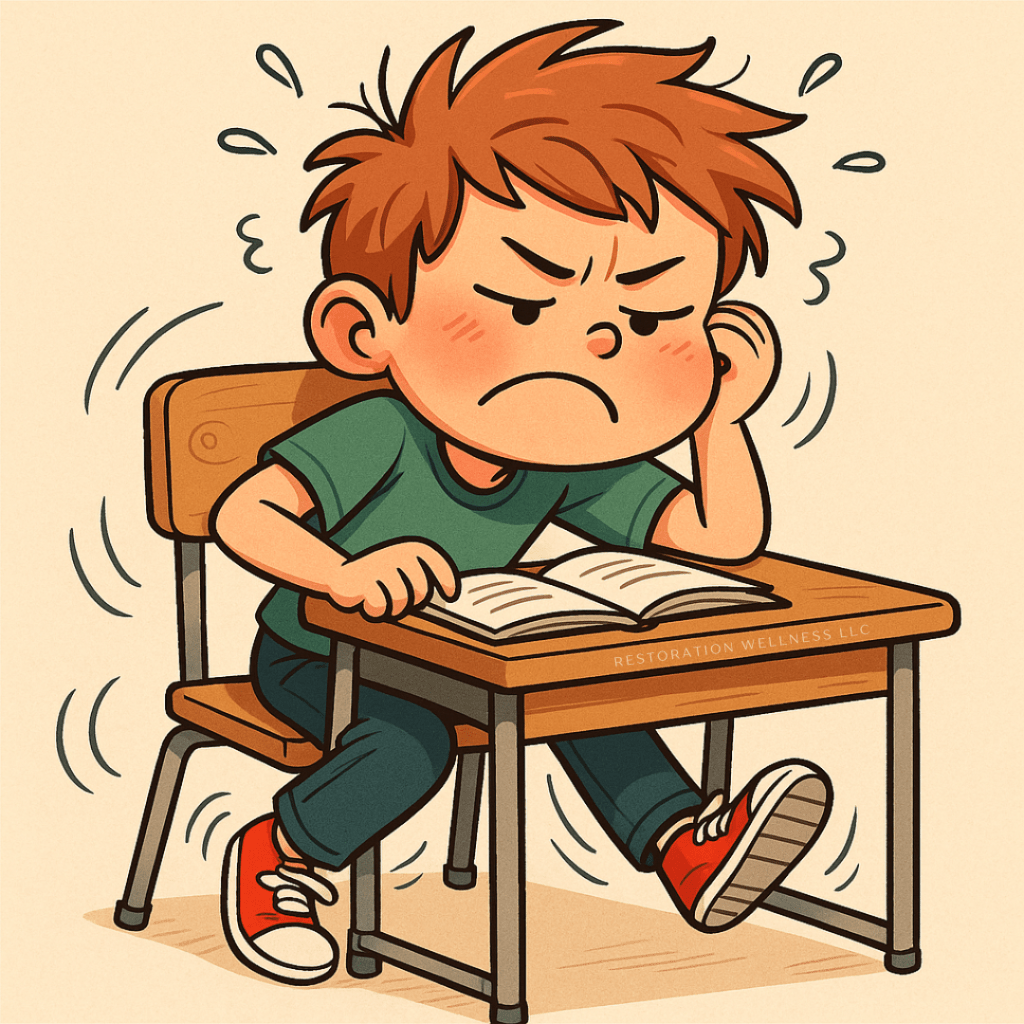
- And the magical moment your child comes home and says, “We had to sit still for how long?!”
(Spoiler: It was 12 minutes.)
Welcome to back-to-school season: where expectations are high, caffeine is higher, and we will do whatever it takes to help our kids walk in regulated —and walk out still intact.
Let’s be real: families of neurodivergent kids aren’t just seasoned—we are over it. We have seen schools confuse “noncompliance” with nervous system dysregulation. We have watched brilliant kids get labeled as problems simply because their mitochondria are underperforming and their sensory systems are on high alert.
After working in one of our local school districts, I saw it all. Most of these kids are not struggling because they are difficult. They are struggling because their bodies are inflamed, their immune systems are overloaded, and their brains are trying to run on fumes. It is not a discipline problem; it is a systems overload.
Let us fix that together with homeopathy, herbs, humor, and a whole lot of “No, you may not touch my child’s sensory diet without consulting me.”
When It Is NOT “Just Behavior”
Behavior is communication. Always. That meltdown? That refusal to go to school? The bathroom accidents? The constant eloping? These aren’t “bad behaviors”, they are survival responses.
Many kids labeled with “oppositional” or “conduct” disorders (like ODD) are actually struggling with undiagnosed learning disabilities or cognitive overload. These labels can mask the real issue and delay proper intervention.
Academic testing is not just helpful—it’s vital. Especially for girls, who are more often misdiagnosed or completely overlooked until symptoms become emotional or behavioral. Missed learning disabilities and delayed diagnoses do not just delay support—they can actually create personality disorders. Chronic invalidation, lack of accommodations, and internalized failure all lay the groundwork for maladaptive coping strategies, that are later pathologized.
So no, your child is not being manipulative. They are telling you something in the only language their overwhelmed nervous system knows how to speak. Let’s listen better.
| Symptom | Possible Root Cause |
| Constant fidgeting | Low vagal tone, EMF exposure, B vitamin deficiency |
| Zoning out | Mitochondrial fatigue, trauma-related freeze response |
| Aggression | Gut dysbiosis, sensory defensiveness, histamine overload |
| School refusal | Inflammation, anxiety, social trauma, mold exposure |
| Elopement | Learning disability, sensory aversion, auditory processing issue |
🌿 Homeopathic Essentials for School Days
| Symptom | Remedy | Description |
|---|---|---|
| Sensory overload | Nux Vomica 30C | For the overstimulated child who wants to crawl into a locker by 10am. |
| Separation anxiety | Pulsatilla 30C | Helps those tearful drop-offs feel less like emotional waterboarding. |
| Test anxiety | Gelsemium 30C | When their brain says “freeze” instead of “go.” |
| Tummy trouble from nerves | Argentum Nitricum 30C | Great for those morning “I have a stomachache” cases. |
| Frustration/aggression | Chamomilla 30C | For the zero-to-table-flip crew. |
| Repeating mistakes | Chestnut Bud | For the child (or adult) stuck on loop—emotionally, academically, or socially. |
Creative Use: Pop these into mini spray bottles or dissolve in water bottles labeled “Brain Juice” or “Calm Potion.” Bonus points if the teacher asks what’s in it and you reply, “Pixie tears and nervous system magic.”
🌸 Bach Flower Allies: Emotional First Aid for Big Feelings
| Emotion | Flower | Use |
| Overwhelm / transition anxiety | Walnut | Protects from emotional overload and routine changes. |
| Fear of failure / Fear of new things | Mimulus | For kids afraid to try, speak up, or engage. |
| Explosive meltdowns | Cherry Plum | For the “I’m about to Hulk Smash” feelings. |
| Low confidence | Larch | Perfect for the child who says, “I can’t” before trying. |
| Obsessive behaviors | Crab Apple | For perfectionist meltdowns and sensory aversions. |
| Learning from mistakes | Chestnut Bud | Encourages awareness and integration of new experiences. |
Creative Use: Add to essential oil rollers, back-to-school bracelets, or calming corner sprays. Or just leave them in plain sight and say, “Mom’s holy water.”
🍵 Herbal & Nutritional Tools for Focus, Immunity & Calm
| Category | Tools | Creative Application |
| Immune Support | Elderberry, Astragalus, Echinacea | “Purple Mustache of Protection” tea before school. |
| Brain Boosters | Lion’s Mane, Ginkgo, Bacopa | Add to smoothies; rename them “NeuroNinja Shakes.” |
| Nervous System Soothers | Lemon balm, Passionflower, Holy Basil | Use in bedtime tea or stress sprays. |
| Gut-Brain Support | Slippery Elm, Marshmallow Root, Probiotics | “Brain Fuel” lunchbox note included. |
📅 Integrative IEP & 504 Add-Ons
Let us move beyond “preferential seating.” Here are some holistic supports that actually help neurodivergent learners thrive:
- “Use of a fidget and aromatherapy toolkit during transitions.”
- “Scheduled movement breaks using vestibular supports like swings or balance boards.”
- “Permission to use homeopathic or flower essence support sprays under supervision.”
- “Emotional regulation plan with sensory integration tools.”
- “Access to a noise-reducing space or noise-canceling headphones as needed.”
Pro Tip: Include practitioner recommendations as attachments to the IEP/504. If the school psychologist sighs, remind them your child is more than a checkmark.
Final Word to the Parents Doing the Real Work
You have sat in more meetings than most school board members and heard every gaslighting phrase known to mankind. You know that “they seem fine at school” really means “we haven’t looked deeper.” You are not “too much.” You are informed.
You have been talked over, dismissed and still showed up with a binder, gluten-free snacks, and essential oil rollers labeled “Calm TF Down.”
This isn’t just back-to-school, it is back-to-battle. But this time, you are showing up with data, direction, and a dose of well-earned sass.
And if anyone questions your methods? Smile sweetly and say, “I’m not anti-science. I’m just pro-mitochondria.” Whether you have been brushed off, misquoted, or called “overprotective,” I see you. You are building your child a life where they feel safe, seen, and supported. That matters more than perfect attendance.
Repeat after me: “I am not raising a student. I am raising a whole human. And I am doing a damn good job.”
Need personalized support? Book an appointment: Client Portal
Subscribe to get access
Mini eBook: The Back-to-School Toolkit for Sensitive Kids
For Parents and Caregivers Who Know It’s Not Just “Bad Behavior”
Read more of this content when you subscribe today.
Discover more from Restoration Wellness, LLC
Subscribe to get the latest posts sent to your email.
 Restoration Wellness, LLC