
Idaho Proposition 1 is officially called the Reproductive Freedom and Privacy Act. Its title sounds compassionate, private, and medically protective. The measure places abortion within the same broad category as contraception, fertility treatment, miscarriage care, childbirth care, and prenatal and postpartum care. That combination encourages voters to see these services as different expressions of the same medical freedom.
They are not the same.
Contraception attempts to prevent pregnancy. Fertility treatment attempts to create pregnancy. Miscarriage care treats a pregnancy that has already been lost or is in the process of being lost. Childbirth care supports a mother and child through delivery. Proposition 1 defines abortion as medical treatment intended to terminate a pregnancy [1].
Placing all these services beneath one reassuring label does not make them medically or morally interchangeable. It does make the legal change harder for an ordinary voter to examine. Someone who supports contraception, miscarriage treatment, in vitro fertilization, or emergency pregnancy care may assume that rejecting Proposition 1 threatens those services. That assumption should not replace careful reading of the measure itself.
My position on abortion is not grounded in personal preference. I do not possess the authority to decide which human lives have value or when innocent life may be intentionally ended. That authority belongs to God. My responsibility is to submit my reasoning, emotions, politics, and personal comfort to His Word.
I am not asking Scripture to endorse an opinion I already hold. I am bringing my opinion beneath the authority of Scripture. When Gods Word commands the protection of innocent life and tells me to speak for those who cannot speak for themselves, obedience does not become optional because the conclusion is controversial.
Proverbs instructs us to speak for those who cannot speak for themselves and defend the rights of the poor and needy [2]. That command is not limited to people who physically lack a voice. A person may be able to speak while lacking the knowledge, power, safety, maturity, or freedom necessary to defend what is being taken from them.
An unborn child cannot explain what abortion will do. A frightened minor may not recognize manipulation by an older partner. A trafficked child may repeat the words she has been instructed to say. A woman receiving a devastating genetic diagnosis may be presented with abortion before she receives meaningful information about specialists, perinatal palliative care, comfort care, grief support, or carrying and honoring her child regardless of the outcome.
Even an intelligent adult voter can be placed at a disadvantage by carefully constructed legal language. Ignorance is not dependent upon age. Words such as privacy, freedom, health care, and medical emergency sound familiar, but their legal operation may be much broader than the ordinary voter realizes.
That is why we must look for the children hidden inside Proposition 1.
What Proposition 1 Actually Creates
Proposition 1 would create a statutory right to make private reproductive health care decisions, including abortion before fetal viability and in medical emergencies. It would restrict the states ability to burden or interfere with the exercise of that right. It would protect people and organizations that assist someone exercising the right. It would also direct courts to interpret the act broadly in favor of reproductive freedom and privacy [1].
This is not merely a declaration that women should receive treatment for miscarriage, ectopic pregnancy, infertility, or pregnancy complications. It creates an affirmative legal right to abortion and establishes a demanding legal standard that state restrictions would have to satisfy.
The measure says that a persons exercise of reproductive freedom cannot be burdened or prohibited, directly or indirectly, unless the state action is narrowly tailored to improve or maintain the health of the person seeking care through the least restrictive means [1].
The phrases “narrowly tailored” and “least restrictive means” matter. They create a demanding test for government action. Existing laws concerning abortion could be challenged by arguing that they burden the new right or that a less restrictive alternative could have been used.
Voters are not simply being asked whether women should receive compassionate medical care. They are being asked to establish a broad right and place substantial limits on how Idaho may regulate it.
“Every Person” Includes Minors
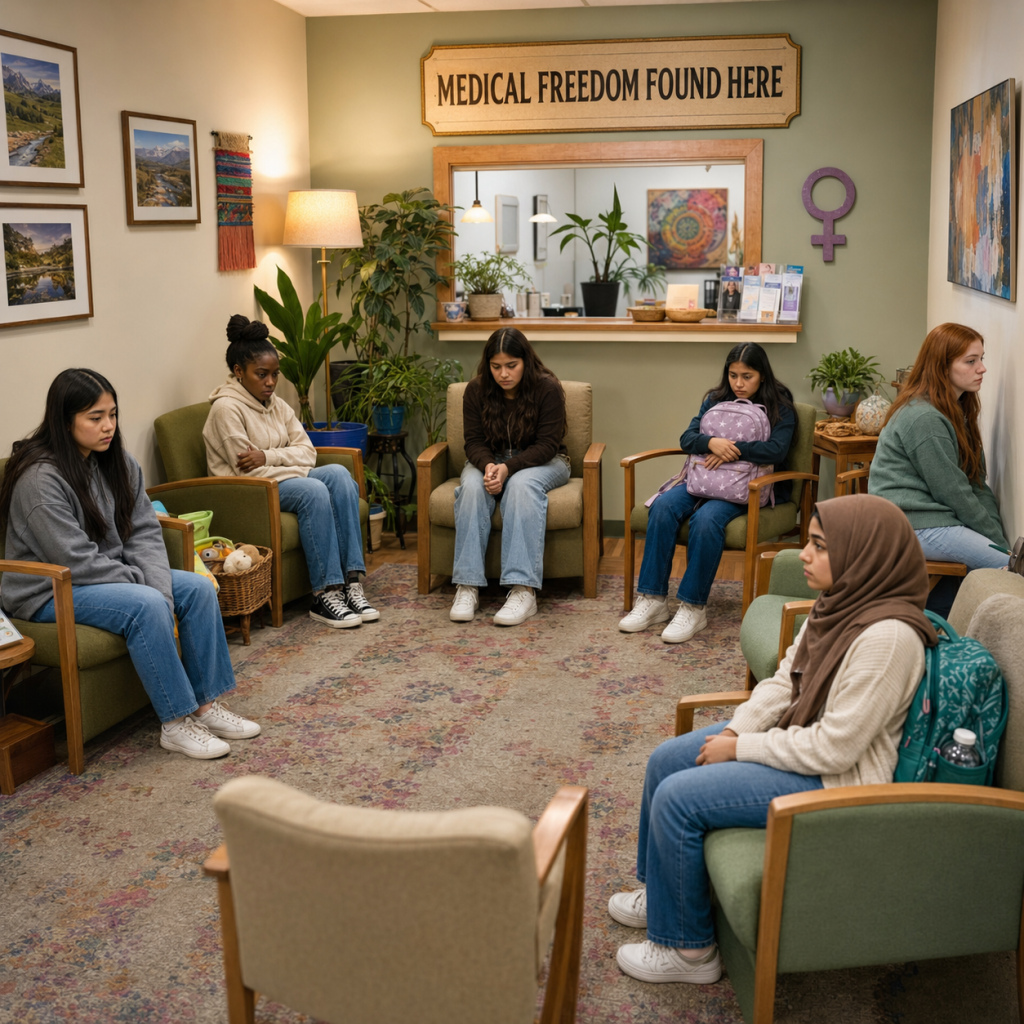
Proposition 1 states that “every person has the right to reproductive freedom and privacy” [1]. The measure contains no age qualification. It does not mention minors, parents, parental notification, parental consent, or parental involvement.
That does not prove that every existing parental requirement would automatically disappear if Proposition 1 became law. The measure has not been interpreted by a court because it has not yet taken effect. It would be inaccurate to claim that it explicitly abolishes parental consent when those words do not appear in the text.
It would be equally irresponsible to reassure parents that nothing could change.
The measure gives the right to every person, supplies no exception for minors, and instructs courts to interpret the act liberally in favor of reproductive freedom and privacy. An existing parental requirement could face a legal challenge under the new narrowly tailored and least restrictive means standard.
Parental involvement is not an absolute guarantee of safety. Some children live with violent, abusive, or unsafe parents. A parent or relative may be the person responsible for the pregnancy. Any honest safeguarding policy must provide a protected route for those children to disclose abuse and receive help.
That reality does not justify writing parents entirely out of the measure without creating a clear replacement safeguard. Removing one form of adult oversight does not automatically make a child independent, informed, or safe. It may simply leave another adult with greater control.
Minors Are Not Simply Smaller Adults
A minor can understand that she is pregnant, frightened, or desperate without possessing an adults ability to recognize manipulation, evaluate long term consequences, resist an older partner, or separate her own wishes from the demands of someone she depends upon. Age does not make her experience unimportant. It makes power, coercion, and safeguarding more important.
Forced sexual initiation frequently occurs while girls are still minors. In a national United States study, the average age of forced first intercourse was 15.6 years. The male partner or assailant was substantially older on average. Women who reported forced sexual initiation also experienced higher rates of unwanted first pregnancy and abortion than women whose first intercourse was voluntary [3].
Pregnant adolescents are not a population in which coercion can safely be treated as a remote possibility. In one multicenter study, 52 percent of pregnant adolescents reported intimate partner victimization. Victimization was also associated with numerous health risk behaviors [4]. Another study found that violence during adolescent pregnancy was associated with substantially higher odds of depression and anxiety [5]. These findings do not prove that any particular abortion is coerced. They demonstrate why meaningful screening for violence and coercion cannot be treated as an optional courtesy.
Reproductive coercion occurs when another person attempts to control pregnancy related decisions. It can include pressure to become pregnant, interference with contraception, pressure to end a pregnancy, or threats tied to the outcome. Research among young adults has found that reproductive coercion frequently overlaps with physical and sexual partner violence [6]. The phrase “her choice” becomes dangerously incomplete when nobody has established whose choice is actually being carried out.
When the Helper Is the Person Causing the Harm
Proposition 1 does not protect only the patient and physician. It says that “any person or entity” may advise, assist, facilitate, inform, refer, or otherwise aid someone exercising the protected right [1]. A trusted relative, counselor, advocate, or medical professional may provide legitimate help. The language, however, is not limited to those people. It does not distinguish a safe helper from a controlling boyfriend, sexually abusive relative, trafficker, or other adult attempting to conceal a crime.
Who verifies that the minor is acting voluntarily? Who speaks with her away from the adult who brought her? Who determines the relationship between the child and the person arranging transportation, payment, referral, or an appointment? What happens when the person assisting with the abortion is the person who caused the pregnancy or profits from the child’s exploitation? Proposition 1 does not answer those questions. It establishes protection for assistance without creating a child specific process for determining whether the assisting adult is safe, coercive, sexually involved with the minor, or financially benefiting from her exploitation.
This omission should concern everyone who claims to oppose child sexual abuse and human trafficking.
Privacy Can Protect a Child or Protect the Adult Hurting Her
Privacy can protect a minor whose home is unsafe. It may give a frightened child an opportunity to speak with a physician or counselor without the abusive person being present. That is an important reality.
Privacy can also conceal abuse.
Pregnancy may expose rape, incest, coercion, or commercial sexual exploitation. It can bring a crime into contact with a physician, nurse, social worker, parent, child protection investigator, or law enforcement officer. An abuser or trafficker may have a powerful reason to end the pregnancy before other people discover it. An abortion can end a pregnancy without ending the abuse. The child may be returned to the same adult, household, trafficker, or coercive relationship. If nobody identifies the underlying crime, the exploitation can continue.
In a United States study of girls affected by commercial sexual exploitation, 31 percent had experienced pregnancy. Among those who had been pregnant, 18 percent had experienced multiple pregnancies. Reported pregnancy outcomes included live births, abortions, miscarriages, and stillbirths [7]. The study does not prove that abortion concealed exploitation. It establishes that pregnancy and abortion are part of the health reality encountered among commercially exploited girls.
Federal guidance also warns that many trafficked young people come into contact with health and social service professionals while remaining unidentified. Health care can therefore become a point of rescue, but only when professionals recognize the signs and have systems for responding appropriately [8].
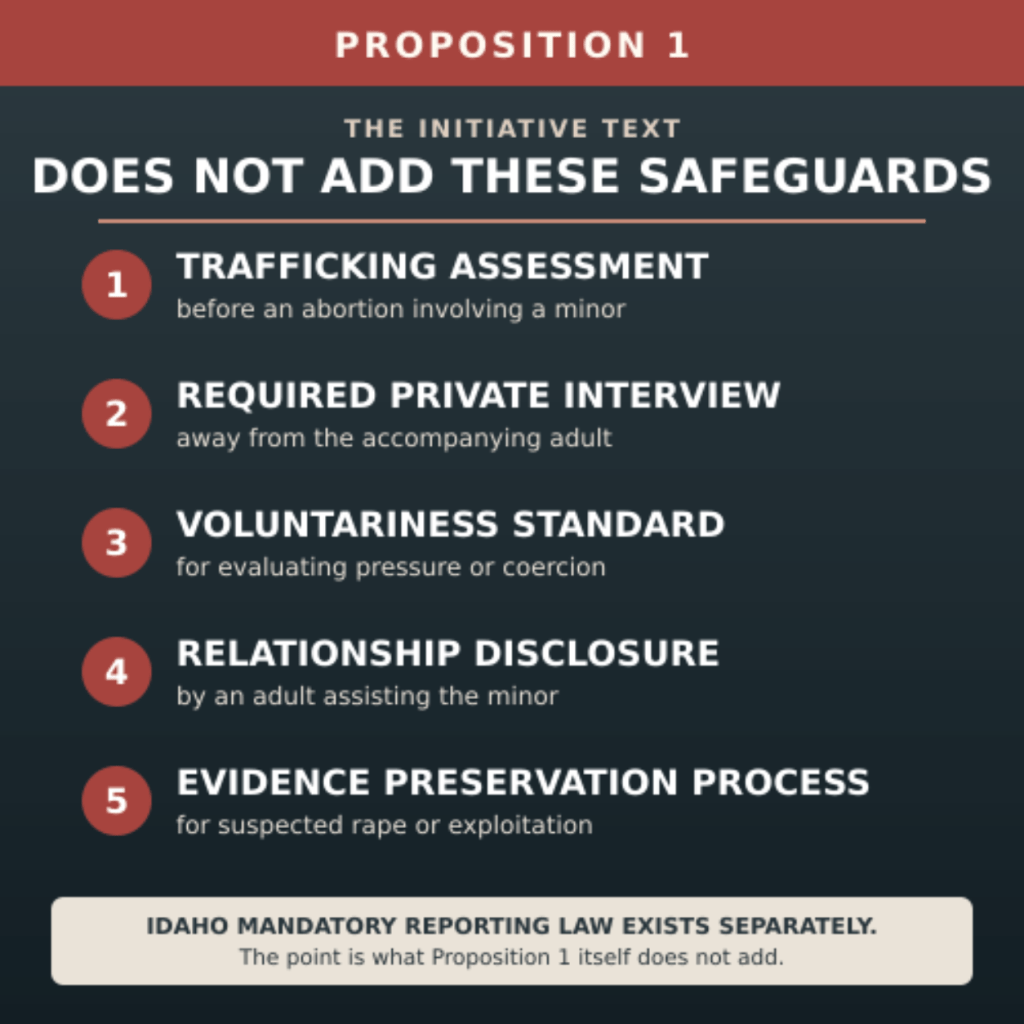
Proposition 1 does not require a trafficking assessment before an abortion involving a minor. It does not require a private interview away from the accompanying adult. It does not explain how voluntariness will be evaluated. It does not require the assisting adult to disclose a relationship to the minor. It does not establish a process for preserving evidence of rape or exploitation.
Those omissions do not prove that medical professionals will ignore abuse. They show that Proposition 1 creates expansive privacy and assistance protections without placing corresponding child safeguarding requirements in the text.
Mandatory Reporting Is Not the Same as Active Safeguarding
Idaho law currently requires physicians, nurses, teachers, social workers, and other people who have reason to believe that a child has been abused, abandoned, or neglected to report the concern within 24 hours. Failure to report is a misdemeanor [9]. Proposition 1 does not expressly repeal that responsibility. Any claim that mandatory reporting would simply disappear would go beyond the text.
Mandatory reporting, however, depends upon someone recognizing a reason to suspect abuse. A reporting law is not the same as a required trafficking assessment. It is not the same as verifying the identity of an accompanying adult. It does not guarantee that a child will be interviewed privately. It does not require a provider to investigate how an adult obtained control over the childs transportation, communication, money, identification, or appointment. Federal training materials acknowledge that youth victims can interact with health professionals and remain unidentified [8]. That is the gap Proposition 1 fails to address.
A voter cannot responsibly claim to oppose child sexual abuse and human trafficking while supporting Proposition 1 without confronting the protections it fails to provide for minors. That does not mean every supporter favors exploitation. It means good intentions do not answer the safeguarding questions created by the measures language.
Protecting children requires more than repeating the word privacy.
Medical Intervention Can Begin Before Survival Is Likely
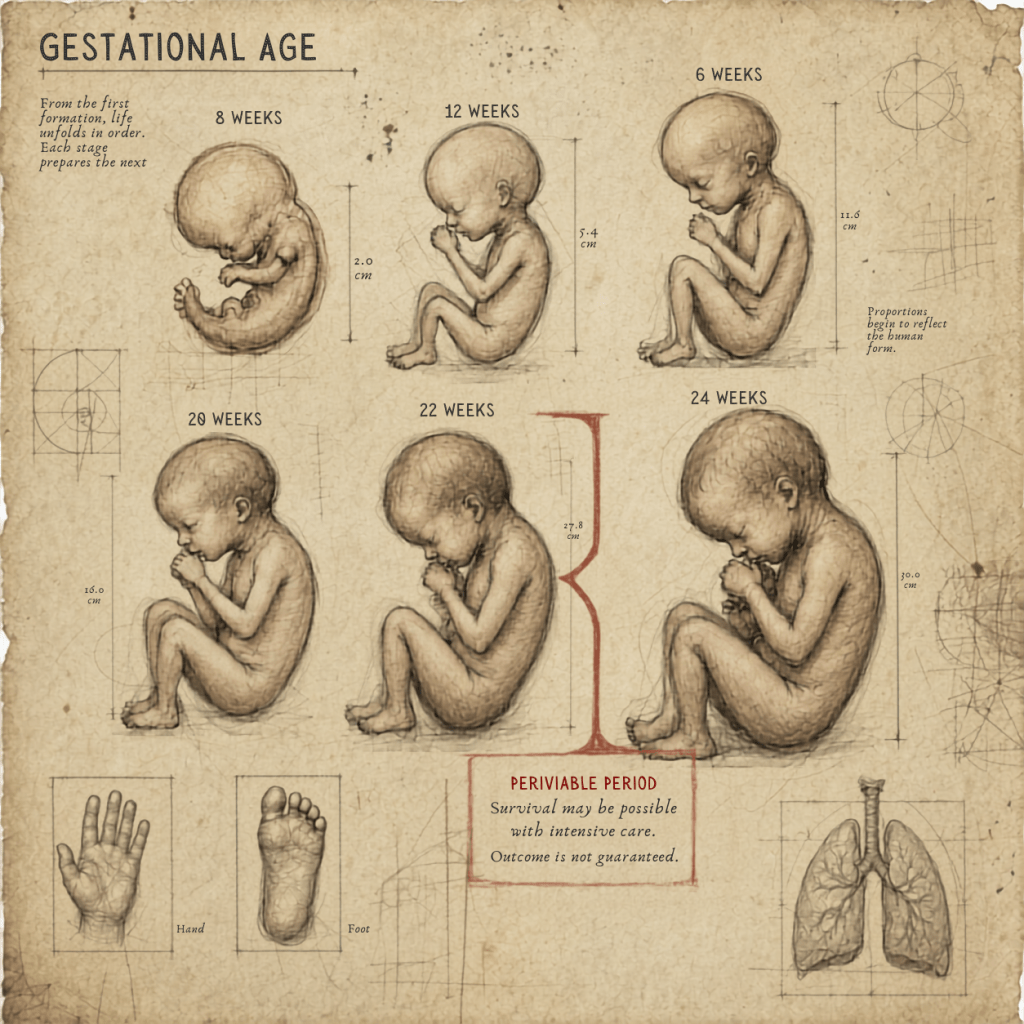
Proposition 1 does not create a fixed gestational limit such as 24 weeks. It defines fetal viability as the point when a physician determines, in good faith and case by case, that the fetus has a significant likelihood of sustained survival outside the uterus without extraordinary medical measures [1].
It is important to describe this honestly. Not every child born at 21 or 22 weeks can survive. Outcomes vary according to gestational age, birth weight, the infants condition, the hospital, available specialists, and whether active treatment is offered. The significant point is that medicine has developed the capability to begin intervention near this threshold.
A multicenter study examined infants born between 22 and 23 weeks who received intensive care. Some mothers began antenatal steroid treatment during the twenty first week. Complete steroid exposure was associated with greater survival among the studied infants, although the small number exposed at 21 weeks did not allow researchers to determine effectiveness separately at that age [10].
Another major neonatal research study found that 30 percent of actively treated infants born at 22 weeks survived. Survival increased with each additional week of gestation [11]. These findings do not promise that a particular child will live. They establish that medicine may have something to offer before survival becomes likely.
Medicine can administer steroids, transfer a mother to a specialized center, prepare a neonatal team, provide respiratory support, control temperature, offer nutrition, and attempt resuscitation. Medicine can intervene. It cannot guarantee life.
The rest belongs to God.
Proposition 1 defines viability partly by whether the child can survive without extraordinary medical measures. That phrase deserves scrutiny because the interventions that save extremely premature infants are extraordinary in intensity while still being established forms of neonatal medicine. A child should not become legally less worthy of protection merely because protecting that child requires more advanced care.
Abortion After Viability
After viability, Proposition 1 allows the state to regulate abortion except in cases of medical emergency. The measure defines medical emergency as a physical condition that, according to a physicians case by case judgment, warrants abortion to protect the pregnant patients life or because delay may place health in serious jeopardy, seriously impair a bodily function, or cause serious dysfunction of an organ or body part [1]. This definition is broader than an exception limited to preventing death. It would be inaccurate to call it an entirely unrestricted right to abortion through birth. Both facts belong in an honest explanation.
The measure gives the physician substantial case specific authority. It does not define every condition that qualifies as serious jeopardy, serious impairment, or serious dysfunction. Those determinations would develop through medical judgment, regulation, litigation, and court interpretation.
Voters should not be told merely that post viability abortion is either completely prohibited or completely unrestricted. They should read the definition and consider how broadly it may operate when combined with the instruction to interpret the act liberally in favor of reproductive freedom.
A Genetic Defect Does Not Cancel a Life
A prenatal genetic diagnosis can be devastating. Parents may suddenly face uncertainty about disability, medical intervention, pain, survival, caregiving, finances, and grief. They deserve accurate information, compassionate support, specialists, and time to understand what the diagnosis does and does not mean. A genetic defect does not make abortion necessary. It does not remove the childs humanity. It provides information about the childs condition and possible outcome.
Medicine does not predict every outcome perfectly. Even when a condition is expected to be fatal, the child can be carried, delivered, comforted, named, held, loved, grieved, and honored. Perinatal palliative care provides coordinated support for families continuing pregnancies affected by life limiting conditions. It can include prenatal consultation, a birth plan, neonatal and pediatric specialists, comfort care, spiritual support, memory making, and bereavement counseling [12].
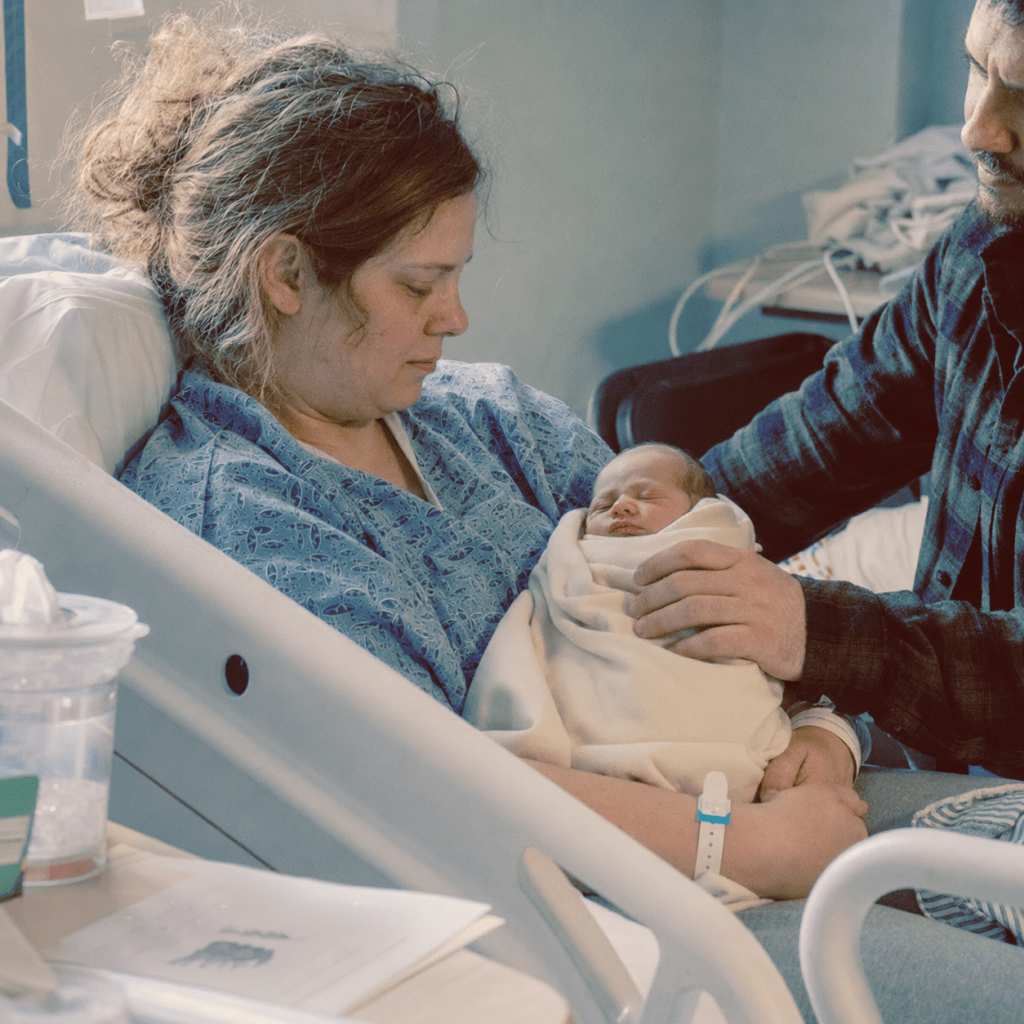
A family may still experience profound grief. Carrying the child does not make the diagnosis painless. It refuses to make death the treatment for anticipated sorrow. Parents should not be encouraged to choose abortion to protect themselves from the emotional pain of watching a child die or facing a funeral. Avoiding a funeral does not prevent death. It changes who chooses the timing and cause of death.
Language matters here too. Bereaved parents may lovingly describe a miscarried or stillborn child as sleeping. I would never police the language a grieving family uses to survive an unbearable loss.
My objection concerns language used to soften intentional fetal death. When an abortion intentionally causes the childs death before delivery, the mother is not simply delivering a sleeping baby. She is delivering a dead child whose death was the intended result of the procedure.
The child is not asleep. The child is dead.That truth is painful, but emotional comfort does not transform death into sleep. Language should support grieving parents without concealing what caused the death.
The Language That Gives Proposition 1 Its Power
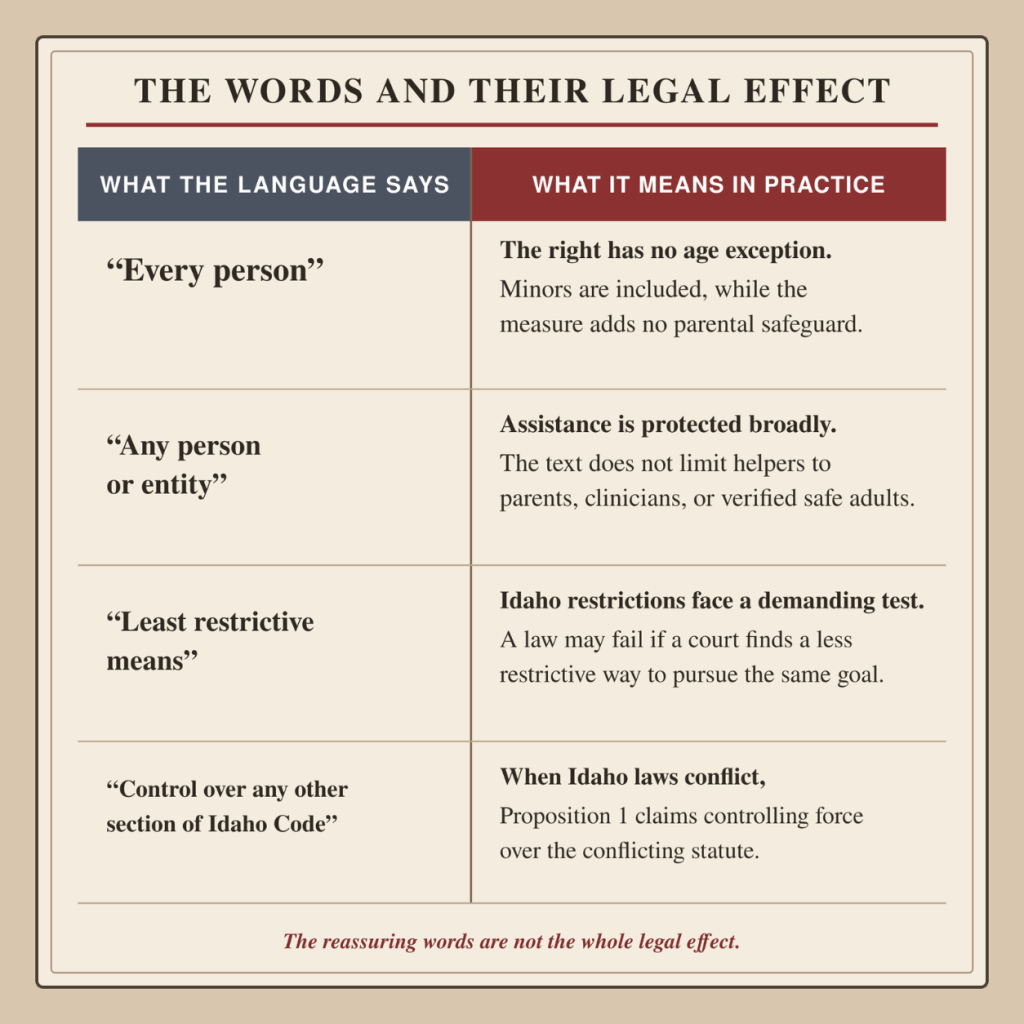
The legal effect of Proposition 1 does not depend only upon the words abortion and viability. Several less familiar phrases determine how broadly the measure could operate. The measure prohibits the state from interfering with the protected right “directly or indirectly, in any manner.” This language extends beyond outright bans and may permit challenges against regulations alleged to create an indirect burden [1].
State action must also be narrowly tailored and use the least restrictive means. These phrases establish a demanding standard for restrictions involving abortion and other protected reproductive decisions. The act then says its provisions must be “liberally construed in favor of reproductive freedom and privacy.” When legal language is unclear, this clause directs courts toward a broad interpretation of the protected right.
Finally, the measure says it is intended to “control over any other section of Idaho Code” [1]. When another Idaho law conflicts with Proposition 1, the new act claims controlling force. These are not harmless additions placed behind a compassionate title. They tell courts how to interpret the measure and how to address conflicts with existing law. The act does preserve several boundaries. It creates no new state obligation to fund reproductive care. Ordinary medical malpractice claims remain. Existing conscience protections for health care providers remain. If one provision is found invalid, other portions may continue [1].
Acknowledging those guardrails does not erase the broader authority the measure creates.
This Is Gods Domain

My conviction about human life begins with the nature and authority of God. Genesis teaches that human beings are made in the image of God [13]. Human dignity is therefore received from God rather than earned through ability, independence, health, wantedness, or social usefulness.
David describes God as forming his inward parts and knitting him together in his mothers womb. He says that Gods eyes saw his unformed substance before his days unfolded in the world [14]. Jeremiah was known by God before birth and appointed to a purpose he could not yet understand or express [15]. These passages are not modern medical statutes. They establish the authority beneath my moral reasoning. Human life in the womb is not invisible to God, and human worth does not begin when medicine declares viability.
The command against murder reflects the sacred value of innocent human life [16]. Proverbs calls us to speak for those who cannot speak for themselves [2]. Jesus places a child in the center of His teaching and gives a severe warning about causing children harm [17]. Children belong within Gods protective domain. That includes the unborn child, the frightened minor, the disabled child, the trafficked girl, and the child carrying a life limiting genetic defect. It also includes people whose ignorance makes them vulnerable. A voter who does not understand legal language still bears responsibility for a vote, but leaders and advocates also bear responsibility for explaining the measure truthfully. Softened words should not be used to obtain consent that clear language might not receive.
My Definition of a Consistent Pro Life Position
Human life begins at conception and deserves protection regardless of disability, genetic defect, rape, incest, poverty, relationship circumstances, or parental preference.
An ectopic pregnancy is different because it cannot result in a live birth and continuing it can kill the mother. Treating an ectopic pregnancy addresses a condition in which the child cannot survive. It is not morally equivalent to intentionally ending a pregnancy because the child is unwanted, disabled, conceived through violence, or expected to die after birth. A life limiting genetic diagnosis calls for truth, preparation, medical support, comfort, birth, grief, and honor. The childs life remains worthy even when it may be brief. The possibility of a funeral does not give us moral authority to cause the death we fear grieving. Conception through rape does not make the child guilty of the father’s crime. The mother deserves protection, trauma informed care, justice, practical assistance, and long-term support. The child should not receive a death sentence for the violence committed by someone else. Poverty does not erase humanity. Disability does not erase humanity. Dependence does not erase humanity. Fear does not erase humanity. A parents emotional suffering does not erase the humanity of the child whose death is being considered as the solution.
This is not an easy standard. Obedience is not measured by how little it costs. Christian faithfulness often requires us to remain present in suffering rather than ending another life to escape our own pain.
Freedom Does Not Remove Moral Cost
The language of choice can make freedom sound self contained. It is not. Every exercise of free will affects other people and remains accountable to God.
I do not deny the physical, emotional, financial, and relational demands of pregnancy. I do not deny the terror of rape, the grief of a severe diagnosis, the exhaustion of disability caregiving, or the fear of raising a child without adequate support. Those realities demand a meaningful response from families, churches, medical systems, and communities.
They do NOT make another human life disposable.
The law may classify abortion as medical treatment. My conviction remains that abortion intentionally ends a developing human life. I will not call the intentional ending of innocent human life medical freedom merely because freedom sounds more comfortable than death. This is about free will, but free will does not erase consequences. Every decision costs someone something somewhere. In abortion, the human being who dies pays the final cost.
Read Every Word
Idahoans should not vote from a yard sign, a frightening advertisement, a reassuring campaign statement, or a single article, including mine.
Read the complete measure. Pay attention to the phrase “every person.” Notice that minors and parental consent are not addressed. Read the protection given to “any person or entity” that assists. Examine the physician determined viability definition and the phrase “extraordinary medical measures.” Read the complete medical emergency definition. Notice the least restrictive means test. Do not skip the instructions to construe the act liberally and give it control over other Idaho laws. Then ask what the measure protects, what it leaves unprotected, and who may bear the consequences of what it leaves unsaid.
Proposition 1 uses the language of freedom, privacy, and health care. Behind those words are unborn children who cannot speak, minors who may be coerced, trafficked children whose pregnancies may reveal abuse, premature infants who may receive intervention, and children with genetic defects whose lives remain worthy regardless of outcome. Those children are not political abstractions. They are human beings made in the image of God.
We should have the courage to see them before we vote.

References
- Idaho Secretary of State. (2026). Reproductive Freedom and Privacy Act: Official initiative text and ballot materials.
- Crossway. (n.d.). Proverbs 31:8–9, English Standard Version.
- Hawks, L., Woolhandler, S., Himmelstein, D. U., Bor, D. H., Gaffney, A., & McCormick, D. (2019). Association between forced sexual initiation and health outcomes among United States women. JAMA Internal Medicine, 179(11), 1551–1558. https://doi.org/10.1001/jamainternmed.2019.3500
- Udo, I. E., Lewis, J. B., Tobin, J. N., & Ickovics, J. R. (2016). Intimate partner victimization and health risk behaviors among pregnant adolescents. American Journal of Public Health, 106(8), 1457–1459. https://doi.org/10.2105/AJPH.2016.303202
- Thomas, J. L., Lewis, J. B., Martinez, I., Cunningham, S. D., Siddique, M., Tobin, J. N., & Ickovics, J. R. (2019). Associations between intimate partner violence profiles and mental health among low income, urban pregnant adolescents. BMC Pregnancy and Childbirth, 19, 120. https://doi.org/10.1186/s12884-019-2256-0
- Muñoz, E. A., Le, V. D., Lu, Y., Shorey, R. C., & Temple, J. R. (2023). Reproductive coercion and intimate partner violence victimization among a racially and ethnically diverse young adult sample. Journal of Interpersonal Violence, 38(1–2), 1261–1278. https://doi.org/10.1177/08862605221092349
- Barnert, E. S., Godoy, S. M., Hammond, I., Kelly, M. A., Thompson, L. R., Mondal, S., & Bath, E. P. (2020). Pregnancy outcomes among girls impacted by commercial sexual exploitation. Academic Pediatrics, 20(4), 455–459. https://doi.org/10.1016/j.acap.2019.12.005
- Family and Youth Services Bureau. (2024). SOAR to health and wellness: Human trafficking training. U.S. Department of Health and Human Services.
- Idaho Code § 16-1605. (2025). Reporting of abuse, abandonment, or neglect.
- Chawla, S., Wyckoff, M. H., Rysavy, M. A., et al. (2022). Association of antenatal steroid exposure at 21 to 22 weeks of gestation with neonatal survival and survival without morbidities. JAMA Network Open, 5(9), e2233331. https://doi.org/10.1001/jamanetworkopen.2022.33331
- Bell, E. F., et al. (2022). Mortality, in hospital morbidity, care practices, and two year outcomes for extremely preterm infants in the United States, 2013–2018. JAMA, 327(3), 248–263. https://doi.org/10.1001/jama.2021.23580
- American College of Obstetricians and Gynecologists. (2019). Perinatal palliative care. Committee Opinion No. 786. Reaffirmed 2024.
- Crossway. (n.d.). Genesis 1:27, English Standard Version.
- Crossway. (n.d.). Psalm 139:13–16, English Standard Version.
- Crossway. (n.d.). Jeremiah 1:5, English Standard Version.
- Crossway. (n.d.). Exodus 20:13, English Standard Version.
- Crossway. (n.d.). Matthew 18:1–6, English Standard Version.

Discover more from
Subscribe to get the latest posts sent to your email.
 restorationwellnessofidaho.com